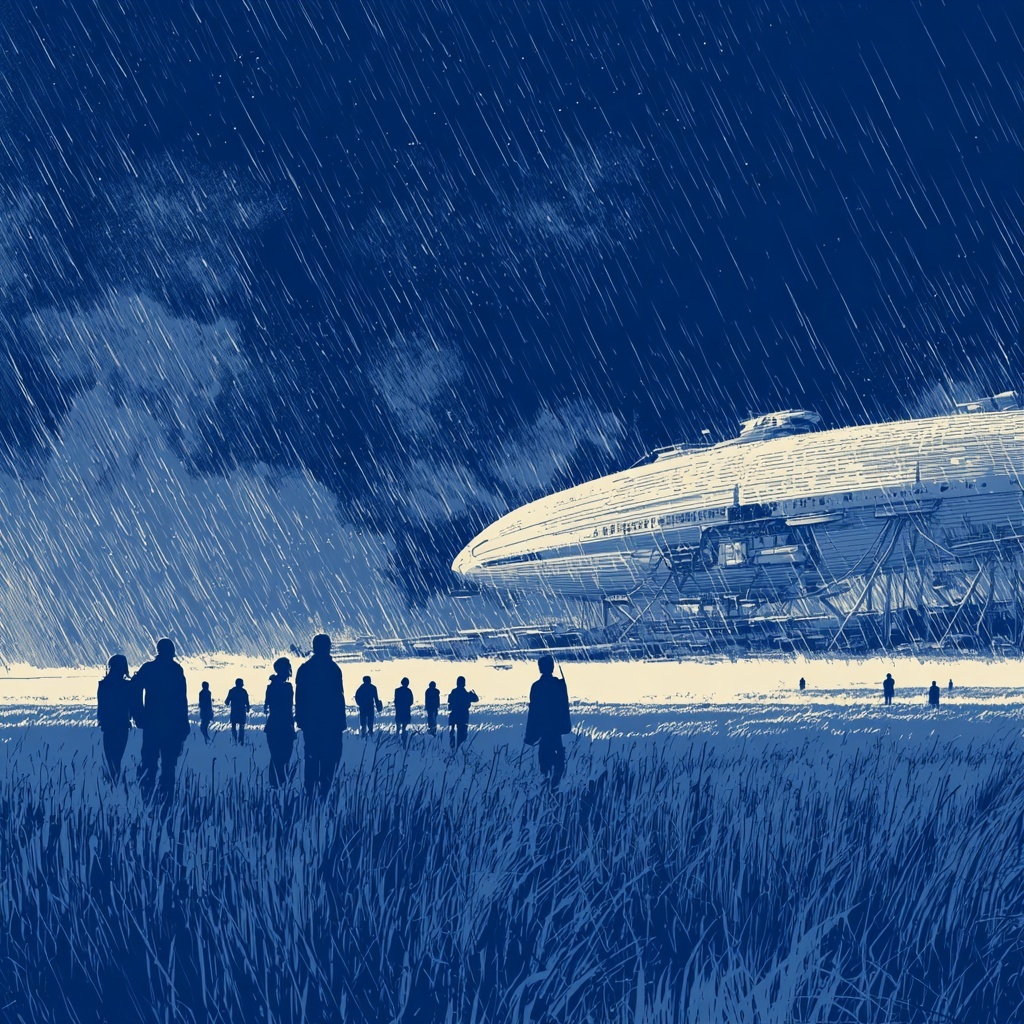
When we first arrived, my wife said, “It’s so blue.” She didn’t know how right she was. Tara appreciated the little things; that’s what I loved about her.
It was a wet planet. That’s why we chose it. Engineering the climate to get the air just right for humans took nearly a century, but we were asleep for most of that time anyway. When the ship full of a thousand migrants landed and we all came out of cryo, the sun was shining, the air was clean, and the machines had completed building the town.
Captain Lance Dulles was the first one to step off the ship. He was slow walking down the ramp—not because he was an older man, but because years in the StarFleet made him cautious. The grass was green and the air was thick, humid. He squinted, gazing around as he took step after skeptical step across the green field toward the town. He paused and turned back to the ship, giving a confident nod. A few more folks walked slowly down the ramp. Then dozens more followed. Then a flood of people poured out of the ship—walking, running, dancing, free from confinement and basking in the sun.
The parade of people walked into town through vertical farms, an industrial printing facility, a school, a town hall, a public square, and a hospital. The hospital was still empty. Some amenities, like medical equipment, weren’t scheduled to arrive until about a month after our landing. Had the medical equipment gotten there sooner, I don’t think it would have made much difference.
Beyond main street were blocks and blocks of small three bedroom homes. Every single migrant on the ship was married—all except old Captain Dulles—and every young couple was assigned a home upon arrival.
“Which one is ours?” Tara asked.
“That one, there,” I said, pointing. “Two twenty two.”
“Oh, I love it!” she said.
“It’s the same as all the others,” I told her. “It’s not anything special.”
“Ours is the only one with the number two twenty two on the door,” she retorted with a smile and a raised eyebrow. “Besides, we’ll make it special. We’ll decorate it and make it our own.”
I rolled my eyes, but she didn’t see. She was off running toward the house, shouting, “Come on.” She was like a kid on Christmas morning.
It was her idea to come here. She was always curious, always ready for an adventure, and this was the adventure of a lifetime. I was excited for it myself, of course. But even if I wasn’t, even if I knew I was marching myself into purgatory, I would still do it just to make her happy. I wanted to give her the world, and this seemed pretty damn close.
It was a starter home with room to grow. The house was furnished with the necessities. Tara darted from room to room taking it all in, moving too fast to keep up. The whole time she was thinking out loud about painting the walls and rearranging the living room, and saying if we had four kids it had to be exactly two boys and two girls because we couldn’t fit three in one room. I was checking for leaks under the sink and shoddy drywall work in the kitchen.
“What about four girls?” I asked.
“That would be too much,” she shouted back from across the house.
I found her in one of the bedrooms. “What about four boys?” I said, standing in the doorway.
“Honey,” she said flatly. “No.”
I stepped closer and held her by the hips. “Unfortunately, I don’t think you have any control over that,” I said with a smirk.
She smiled and said, “And you do?”
“Don’t doubt me.”
“We could test this right now,” she said.
Before I could respond, a crack of lightning flashed through the window, and water poured against the glass. Her eyes lit up and she turned to look outside.
“A sunshower! You know what that means.” She started walking towards the door
“There’s lightning, dear. It could be dangerous.”
“It’s the first rain. I have to go out there.”
“We could do other first things.”
“There’s always time for that. There’s only one first rain.”
There was no arguing when she had her mind made up. She grabbed my hand and dragged me through the house, and outside onto the lawn. She pranced about, and did a cartwheel, and we swayed together soaking wet. We weren’t the only ones out there.
It rained every day. The showers were spotty, and the sun never disappeared, the skies always stayed blue, but not a single day went by without rain. The rain caught us in the garden, it caught us on the way to the market, it caught us enjoying a stroll through the meadows. There was no escaping it. If you got lucky with the morning shower, you got unlucky with the afternoon shower. But it was okay. We were all just happy to be there.
I was in the lab, hunched over soil samples from a field a hundred miles out, when she called me. Tara’s voice was faint and strained. “I don’t feel right, Don,” she said. “My stomach… it’s bad.” I dropped everything. My heart pounded as I ran through the sunlit drizzle to the hospital. The town was too quiet. There was a woman leaning against a brick wall with a tense look and a hand wrapped around her stomach. I didn’t stop. I couldn’t.
At the hospital, Tara lay on a cot with bright eyes and a pale face. “Took you long enough,” she teased.
I gripped her hand, forcing a smile. “I’m here now.”
“It’s probably some silly food poisoning or something,” she said, but her grip tightened.
Dr. Patel, barely thirty herself, hovered nearby. I left the room to talk to her.
“Jake, we’ve got others,” she said quietly. “Stella, Kate, Mallory—all in today with abdominal pain and fainting. Something’s wrong.”
“Wrong how?” I asked, my voice sharper than I meant.
She shook her head. “We don’t have the equipment to do scans. I’m flying blind.”
“Do you have any guesses?”
“Them coming in all at once, I’d say it’s something viral, but no one is running a fever. Food poisoning is possible, but they haven’t eaten the same meals. This just doesn’t make sense.”
“Get back to me when it does make sense,” I snapped and turned back to my wife. I was frustrated she didn’t have more to say. It wasn’t her fault, though. No one could have suspected this.
I wish I could say I spent that day with my wife. I did, for the most part, but over the next few hours several more patients came in, and I had to get answers. I thought I had more time.
It wasn’t long before a clear pattern formed. Every patient was a woman. Dr. Patel was developing stomach pain herself. Dr. Pietro Vitran had to fill her shoes. He was just twenty-five.
It wasn’t long before Captain Dulles appeared in the doorway, his gray hair damp from the rain, his StarFleet jacket slung over one shoulder. Word had been spreading about the mysterious illness.
“How’s she holding up, Jake?” he asked, voice low.
“She’s a fighter.”
“Tell him I’m fine, Lance,” she said. “He’s being dramatic.”
Dulles chuckled, but it didn’t reach his eyes. He glanced at Dr. Vitran. “What’s the count now?”
“Twelve women,” Vitran said. “All the same. Rapid onset, no clear cause.”
Dulles nodded. His wife had died just a few months before the ship left Earth. She always dreamed of going off world, so after she died, lead this expedition seemed like a great way to honor her. Taking a look at Tara, and the chaos unfolding in the rest of the hospital, he was growing concerned he would shortly have to offer guidance of a different kind. “Keep me posted,” he said, then turned to me. “Stay with her, Jake. Don’t let her out of your sight.”
The hours dragged. Tara faded, her zest for life grew stale and her jokes dried up she drew short breaths.
Across the hall, I heard Ellen’s husband, Mark, shouting, “She was fine yesterday!” Sarah’s husband, barely twenty, sobbed in the waiting area.
The rain kept falling, taunting as it tapped the windows. Dulles did his rounds, moving from room to room. A steady hand on a shoulder here, a quiet word there.
“Why’s this happening?” Mark snapped, his voice breaking. “What’s doing this?”
Dulles didn’t answer. He just looked out at the rain, his jaw tight.
By nightfall, Tara was slipping. Her hand went limp in mine, her eyes half-closed. “Jake,” she whispered, “promise me you’ll keep going. For us.”
I shook my head. “I can’t,” I said, my throat burning. “Not without you.”
“You can,” she said, fierce even now. “You’re stronger than you think.”
She was gone before midnight.
The hospital rang with grief—husbands cursing, crying, begging. Dulles stood in the hall, staring at the floor. It seemed for every woman that passed, two more came in with the same symptoms, marked for death. I wouldn’t know. I was off chucking rocks in a meadow, teary eyed and soaking wet.
The autopsies came a week later, after the last woman—Dr. Patel herself—died. Dr. Vitran confirmed what Patel was coming to suspect. Ovarian cancer, impossibly aggressive, triggered by a toxin in the rain. Something in the planet’s water, missed by a century of engineering, targeted women’s biology with surgical precision. The men were untouched. It was no comfort. We were five hundred widowers with our visions for the future ripped out from under our feet.
Once the dust settled, Captain Dulles kept a steady voice at town hall meetings. “We have to keep building. It’s what they would have wanted.” Dulles sent a message into deepspace, informing the world of what had occurred here. He insisted more migrants might come in the future, that they might solve the rain problem and that we can do our part by giving them a warm welcome.
Most of us carried on for a few weeks. We all felt numb, hollow, but we also felt accountable to our fellow man. Someone had to be responsible for keeping the fields tilled and the printers maintained. We tried to stay busy and build healthy habits to work through the grief. We exercised and got sun when we could. We played games and laughed and ate meals together. But at the end of the day, that empty feeling crept up again. It wasn’t long before we got the feeling our toiling was all for naught. Without the women, there was no spark of life. We were Adam before Eve. A brotherhood stranded in the rain.
The reality was, it would be years before Dulles would get a return message, let alone a rescue ship, or a new wave of migrants. It was easy to do my part for my next door neighbor. But building a colony for migrants that might never come, that I’ll certainly never meet? Most of us agreed that was beyond the pale. One by one, we made the choice to return to our ship.
“Are you sure you want to do this?” Dulles asked me as I stepped into my cryopod.
“Yeah,” I nodded. “There’s nothing here for me—for any of us. I’d rather wait for something else to come along.”
“You might be waiting forever. You might never come out of cryo.”
I shrugged and gave a somber look. “Waiting in here, waiting out there. It’s all the same.”
His mouth twitched and looked away. After a pause, he said, “You know, sometimes I still feel like Mary’s with me. Something will remind me of her, or I’ll find myself in a tough situation and I’ll ask, ‘What would Mary do?’ It’s like she never left. Do you feel that way about Tara?”
“All the time,” I said. “Every night I dream about her. And then the morning comes and she’s gone. She’s the only dream I have. That’s why I’m doing this. I go down for the long sleep, and either a new wave of migrants comes and wakes me with a new life to live, or I sleep forever and I spend eternity with her.”
“It’s just in your mind,” he uttered.
“That’s all that’s left of her. I’ll take what I can get.”
He looked down and gave a nod.
I leaned back and rested my head on the padding. Dulles closed the cryopod and hit the button. The air thinned and the glass case grew frosty. Everything hardened, and all I saw was a cold blue.
For fun, scifi themed coasters, check out my Etsy shop here: https://scifideco.etsy.com
If you enjoyed this story, be sure to share the link with friends and sign up for my newsletter to never miss a new short story:


 Brian J Mundell