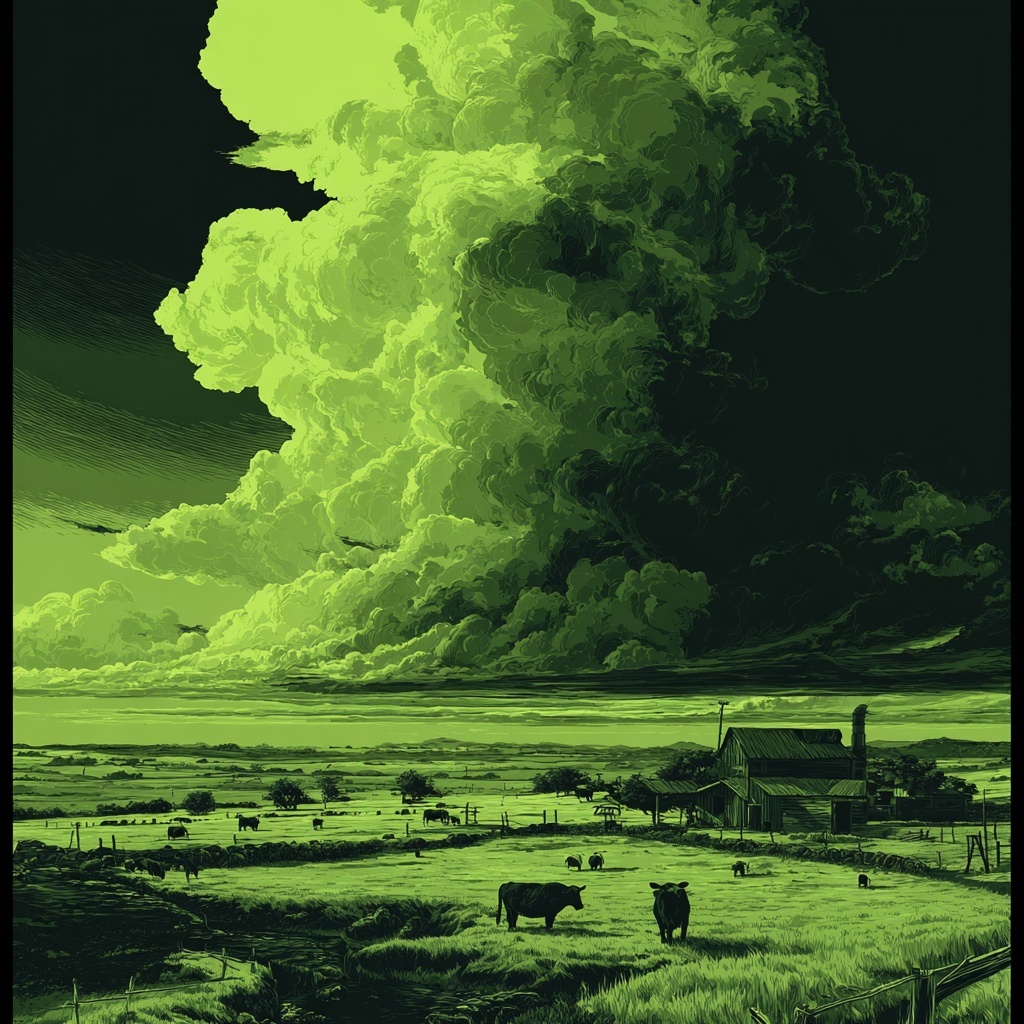
“It’s a fine farm you’ve got here, Cliff,” the man in the suit said as the two walked across the field. “You could fit two, maybe three times the cattle on these acres.”
Cliff Goodall wiped the sweat from his brow. The sun beamed down on the green Kansas pastures like a relentless overseer. He was happy to give Todd Bueller a tour—especially on a hot day where not much work would get done anyway—but businessmen like him were always after the same thing, and he’d come to expect this sort of talk. “Why would I want to do that?” he asked.
Bueller belted out a laugh. “Why does anyone do anything? Money, of course.”
“That’s not why I do things.” The air was dry, smelling of fresh hay and dusty earth, mingled with the faint tang of manure from the barn behind them as they continued their walk to the house. Cliff’s herd of fifty Angus cattle grazed lazily, their black coats gleaming under the clear sky in every direction. He prided himself on their contentment—wide fields, no feedlots, just grass and freedom. He continued, “If I put more cattle in the fields, well, I don’t think my cows would like that very much.”
“Ah, Cliff. If you wanna make it in the world, you have to be practical. You can’t be such an idealist. Who cares what the cows want?”
“It’s not about what the cows want. It’s about what’s good for them. What’s good for them is good for us. Happy cows make high-quality beef. It’s science. The meat is a deeper red. It’s more nutritious, more flavorful, and the marbling is just right. You only get that by giving them space and freedom to roam. That’s how we do things here.”
Bueller stopped walking and Cliff turned to face him. He adjusted his lapels and buttoned his jacket and said with a stern face, “Here’s the hard truth. I can’t partner with you at the prices you’re asking. There’s just too much cost to the processing and distribution, and my buyers won’t like the prices I’d have to charge to stay profitable. The only way this works is if you scale up your operation and—and increase your cattle per acre to get those prices down.”
“I won’t sacrifice quality. It’s not right for the cows, and it’s not right for the customers.”
“Then I’m afraid we can’t do business.”
Cliff exhaled. “Very well. I’ll keep selling to the local butchers.”
The man squinted at Cliff, contemplating the unexpected stance. “If you change your mind…” he said, his voice trailing off. He gave a nod and turned to walk toward his car. A cloud of dust stirred behind him as he drove off.
Inside the farmhouse kitchen, Mary was chopping vegetables, the television droning in the background. “What’s for dinner?” he asked. “Lambchops?”
“That’s wishful thinking,” she replied. “You know I don’t like lamb.”
“I do,” he said with a smile. “I love lamb.”
“Well, you can make lamb chops the next time you cook,” she said with a light sass.
“I don’t cook, honey. That’s what you’re here for,” he joked back.
“How’d the meeting go?” she asked.
“Same as always,” Cliff replied.
“Oh well. It’s their loss. We’ve got the best beef in the country.”
“Best beef in the world, if you ask me. You know what I say. Happy cows, happy customers.”
Mary smiled and nodded at the familiar motto. “What about that Japanese stuff? That Wak—Waggee—”
“Wagyu,” Cliff corrected with an eyeroll. “It’s a novelty. Like chocolate cake. You don’t want to eat that everyday. It’s not good for you. No, we’ve got the good stuff.”
“Believe it or not, some people eat chocolate cake everyday. You know the kids would if they could.”
“Doesn’t mean it’s good for them.”
“Well, it’s a good thing they’ve got you to keep them in line,” Mary said with a smile.
Cliff gave no response. His eyes lingered on the television in the other room as the newsman reported the rising social media addiction.
“Experts are blaming the highly curated feeds and the algorithms behind these apps that are engineered to maximize dopamine release in its users. Efforts to increase engagement on these apps typically comes from the top down, starting with the founders and CEOs, but former users are advocating for more regulation surrounding the development—”
“Earth to Cliff?” Mary said. He glanced over to her. “I said it’s a good thing the kids have you to keep them in line.”
“Oh, yeah,” Cliff stammered. “Well, I do my best. The world’s going soft, ya know.” He shouted to his son and daughter in the other room, “Hey kids, you know what? You should really play outside more often. It’s beautiful out.”
“Uh-huh,” Sarah said from the couch. She didn’t even bother to look up as she was glued to her phone. Jake’s face glowed from his, unresponsive.
Cliff stepped back into the kitchen.
“When I was their age I was outside riding bikes and playing kickball everyday.”
“I know, sweetheart,” Mary said. “Different times, I guess. Go wash up. Dinner’s almost ready.”
That night, as Cliff and Mary lay in bed, a low rumble shook the windows. Cliff rolled out of bed in the dark, his wife fast asleep, and peered through the curtains. Ominous clouds boiled over the horizon toward the farm. The starry night was blocked out by dark swirls—swirls that drifted ever closer, almost moving with a purpose. Cliff held his sharp gaze, gripping the curtains tighter in his callused hands.
“Honey,” he whispered without detracting his focus. His wife remained still. “Mary,” he said aloud. She rolled her head and the whites of her eyes were visible in the night. “Did they say anything about a storm on the news?”
“No,” she said, raspy.
“It looks like a storm’s brewing.”
“The news was wrong,” she said, her voice faint.
The clouds slowed to a halt over the fields, still swirling. A chorus of unease cut through the dark as the cows lowed in distress. The herd of black cattle was hardly visible as they trotted in unison toward the barn, toward safety. Cliff thought of the pregnant heifer. His heart tightened. “The clouds are spooking them.” Another low rumble bellowed, and moos cried out.
“They’ve been through storms before, they’ll be fine. Come back to bed.”
Cliff peered out the window a moment longer. The herd had gathered in and around the barn, and there didn’t seem to be much wind or rain. Reluctantly, he turned away from the window and returned to bed, trusting the cows could take care of themselves.
The next morning, Cliff trudged to the pasture, the grass still dewy under his boots. The sky was calm and the morning air crisp, yet the herd milled about restlessly, eyes wide, lowing softly as if whispering warnings. He found Bessie near the barn and patted her flank, her stomach swollen and her neck tense. The pregnant heifer shook her head and huffed, her lips flapping.
“Easy, girl. What’s got you riled?” He glanced around. There was no rain the night before, and no wind that he heard of—no fallen trees or broken fences either. The only thing out of the ordinary was the herd’s behavior; they moved slowly and when they weren’t looking at him with desperation, their dark eyes stared blankly in the distance. Cliff didn’t want his cows to remain stressed much longer, but with the clouds long gone, he was unsure what could still be causing such unease. Deep in the field, he found his answer.
Cliff spotted a black mass hidden among the waving pastures. It was still, lifeless. He recognized it as a cow by the sheen of the hide, but as he approached, he saw pink and white. The strong smell emitting from the body forced him to pause just a few feet away. Waves of confusion, despair, and frustration came over him as he took in the scene. The cow’s carcass lay on its side, cold and abandoned, its innards visible through a clean slice across the stomach. The carcass was a shell, carved with a surgical precision and robbed of its organs. All that was left was skin, muscle meat, and bones. No blood, no tracks. The smell was not rot. It was bleach. Scavengers had no interest in the body, and the area was devoid of flies and other bugs ready to pick the body clean.
Cliff’s stomach churned. Who would do this?
Over lunch, Mary asked Cliff, “What were you doing in the fields all morning?”
“I found a dead cow out there,” Cliff replied. “Daisy. She must have been attacked or something.”
“Oh no!” Mary said, upset by the news. “Do you think it was a coyote?”
“I don’t know. I don’t think it was an animal at all. It was too clean.”
“You think it was some kids? Like some kind of…prank?” she asked.
“Maybe,” Cliff replied slowly. “The cuts were still too clean for that. It was someone smart, someone who really knew what they were doing. I don’t think a few kids could do that.”
“Well, then what was it?”
“I don’t know, but I’m hoping to find out. I spent all morning setting up trail cameras with night vision all around the barn and a few out in the fields up on trees. If it happens again, catch who did it.”
Cliff spent the rest of the afternoon tending to the herd, making sure they were relaxed and comfortable. “Happy cows,” he repeated to himself. That was the most important thing for his business.
That night, rather than going to bed, he set up a chair by the window in the living room and kept an eye on the fields. He put the television on to listen to the news, but his mind was swarmed by thoughts of catching the vandals responsible for killing his cow. The sky grew dark as the evening wore on, and the only light came from a faint halfmoon. The news reporters tore through stories on tech innovations, the latest box office hits, and rising obesity rates. The chair he sat in was quite comfortable. Late in the evening, after no sign of action, Cliff found his eyes drooping.
Then, a low rumble shook him awake, just like the night before. Outside, the clouds had returned. The darkness covered the moon and stars and rolled over the horizon toward the farm. There was no rain, and no signs of wind. The low rumble sounded almost mechanical as it lacked the instantaneous clap of thunder and instead rang perpetually, growing louder and softer and louder again with regularity. The rumble was only interrupted by the mooing herd.
He wouldn’t let himself be distracted by the clouds. That was merely a coincidence—fortunate weather conditions to give the perpetrator cover. The moos of the herd grew louder, and Cliff’s hands clenched around the arms of the chair. His eyes were focused on the horizon.
A bright flash of light burned wide across the sky. It was unusual for lightning, but not inexplicable. Heat lightning, he supposed. But it only agitated the cows even more. They started to gather and trot across the field seeking safety.
It was then that Cliff decided enough was enough. Something was going on out there, and he was going to put a stop to it. He stood up and marched toward the coat closet, reached up to the top shelf, and pulled down a shotgun. Then he went out of the house and jogged into the field.
The cows’ moos rose to panicked bellows. The herd needed him. Out in the field, he came to a stop, raised the gun to his sights and scanned the landscape for any trespassers, preparing to chase them off the property. His heart raced, but he saw nothing.
Lights flashed from above. More heat lightning?
The clouds had paused where they were, and the low rumble went silent. The cows, too, went silent, and Cliff’s heart raced all the more. He lowered his gun and stared at the phenomenon across the way. The dark swirls thinned and a steady glow emerged from within. The white light grew so strong, it was like a second moon. A single beam flickered on like a stagelight, casting a faint green glow directly on the ground. A cow lowed in terror and lifted in the air.
Eyes wide, Cliff sprang to action. Gun in hand, he sprinted toward the clouds, the glowing craft, the beam of light. Above all, he sprinted toward his cow. “Get away from her!” he shouted—at who, or what, he didn’t know. He fired into the sky, shots echoing uselessly. The cow was fifty, a hundred feet up by now, and before he knew it, Cliff was beneath the hovering white lights. The green beam caught him mid-stride and a tingling warmth—like pins and needles everywhere—overcame him. His body was weightless. In shock, the gun slipped from his hand and fell to the ground two stories below. He floated upward, feet flailing, arms reaching to the sky. The silhouette of his cow was swallowed by the bright light above, and soon so was he.
“I didn’t hear you come in,” Mary’s voice said, still coarse from sleep. Cliff woke in bed, sunlight filtering through curtains.
“I didn’t—I didn’t come in.” He sat up, disoriented. His memories were fragmented.
“Sleeping walking again? You work too much dear.”
Cliff dismissed her and tried to piece together the night before: the stakeout in the living room, the clouds, grabbing his gun, and the lights. The lights! He wore a grave look.
“Are you alright?” Mary asked, concerned.
“I—I don’t know.” He couldn’t remember anything after the lights. His memory was blank, and he wasn’t going to tell a soul about what happened until he had all the facts. “Did you see anything strange last night?”
“No. You were tossing a bit in your sleep, like you were having a nightmare, but you’ve done that before.” She paused, and then asked sincerely, “Honey, what’s wrong?”
Cliff shook his head. “Nothing. I’m fine. Just a nightmare.” She nodded. “I need to get to work,” he added before getting dressed and heading out to the field.
Outside, the pasture waited. Much to his surprise, all was well. The cattle were cheery, and there were no new carcasses lying in the grass. There was no evidence of any wrongdoing. The cameras! Cliff thought.
He raced to the camera with the best view of where the lights were, grabbed the memory card, and uploaded the recording to his computer, only to find there were no files on the drive. No recordings. How is that possible? He checked the other cameras, and it was the same thing with each one. This didn’t sit well with him. The only explanation he could find was that, perhaps, the heat lightning surged the cameras and wiped the memory. That seemed far-fetched, but it was the best he had. He gave a huff and accepted the impossible. The day’s work still remained.
Cliff toiled in the field and brought the cows around and tended to the herd. All the while, he went over the previous night’s events in his head. By the end of the day, however, he figured if the herd was safe and happy, it wasn’t worth the stress.
Mary had dinner ready for him when he came in. She greeted him with a hug and a kiss and was enthusiastic about the meal she had prepared: lamb chops.
“I never thought I’d see the day you cooked lamb chops for dinner,” he said. “This looks delicious.”
“Anything for dear,” she replied. “Kids!” she shouted. “Dinner’s ready!”
Jake and Sarah raced in from the back door. They had been playing outside, and Cliff noted the pleasant surprise. They took their seats at the table and looked delighted at the meal in front of them.
“Thanks for cooking, Mom,” Sarah said.
“Yeah, thanks Mom,” Jake echoed.
“Such grateful kids we have,” Cliff said to his wife. She was beaming. He looked at her closer. Her skin was smooth and pink. Her eyes were sharp. She looked a tad slimmer and she seemed five years younger. She caught him staring from across the table and he gave her a smile.
“Let’s dig in,” she said as she set down a tray of vegetables on the table and took her seat.
The kids filled their plates and ate without complaints. Cliff reached for the biggest lambchop he saw and savored each bite. The tender red meat was such a pleasure, and it was perfectly cooked. As forks scraped and the family chatted, Cliff couldn’t help but probe a little, the day’s odd contentment nagging at him like a loose fence wire. “So, what kept you two outside all afternoon? Haven’t seen you out there like that in ages.”
Sarah looked up, her face flushed from the sun, and launched into it with a grin. “We built this epic fort in the hay bales, Dad—stacked ’em high, just like you used to tell us about your treehouses. And then Jake dared me to climb to the top, and I did! It wobbled a bit, but held steady, like it was waiting for me.”
Jake nodded eagerly, cutting into his chop with gusto. “Yeah, and we found that old rope swing by the creek—swung out over the water, perfect arc every time. Felt like flying.” Their stories tumbled out, bright and seamless, laced with laughs that echoed just right off the kitchen walls. Cliff nodded along, warmth blooming in his chest—real as the steam rising from the platter. Had it been that long since they’d spun tales like this, eyes alight without a screen in sight? But something in the rhythm of it snagged, like a melody he half-remembered from a radio tune, too polished to be their own.
“You never cook lamb, honey. How’d you get this just right?” he asked Mary, shifting his gaze to her.
“I know my way around the kitchen, sweetheart,” she affirmed, her knife gliding through the meat—precise, almost surgical.
He nodded and continued eating. Over the sounds of forks and knives scraping plates, the news played from the other room. “With this new deal, the President is able to end two separate conflicts in the middle east, and secure better trade deals for the U.S. in terms of oil.” That’s good news, Cliff thought to himself.
“Honey,” Mary said, “I meant to tell you, you got a phone call from Todd Bueller. He said he was still interested in doing business.”
“Is that right?” Cliff asked. “Wow, that’s surprising. I didn’t expect that from him.” He spoke quietly, as if he was speaking to himself.
“Well, it’s like you say. Happy cows make happy customers. He couldn’t say no to you. That’s good news, right?” Mary smiled at Cliff from across the table, awaiting a response. The smile didn’t reach her eyes.
“It is,” he said, nodding and shrugging. “There’s a lot of good news, it seems.” She nodded in agreement and continued eating. Her plate was almost empty. “Hey, Mar, you’re really enjoying that lamb, aren’t you?”
“I am. It’s delicious.”
“I thought you didn’t like lamb. What happened?”
Mary froze for a moment. “It’s just been so long since I had it. I guess my tastes have changed.”
“I guess so.” Cliff eyed his wife once more, this time with a quiet skepticism.
“I love lamb,” Jake blurted out.
“I bet you do, son,” Cliff said.
Cliff ate the rest of his dinner in silence, observing his family’s every move. Things were…off…and on any other day, he might have blindly accepted the changes for the better. But not this day. Not after the night he had, seeing those lights in the clouds—the green beam and the white glow. Not after being lifted up off the ground against his will and floating right into…his memory stopped there.
He ground the lamb between his jaws, picking at his plate slowly.
Everything that happened since floating into the light was perfect. Too perfect. Too pleasing. Too full of good news. Doubt crept in as to whether or not the house he woke up in was truly his house. It was as if everything and everyone around him were designed to make him feel happy. Instead, he felt like cattle. His knuckles turned white as he gripped his knife tighter, though he knew whatever this was, a knife wouldn’t get him out.
For fun, scifi themed coasters, check out my Etsy shop here: https://scifideco.etsy.com
If you enjoyed this story, be sure to share the link with friends and sign up for my newsletter to never miss a new short story:


 Brian J Mundell