
Jacob Harlan wiped the condensation from the glass tub, his callused fingers leaving streaks on the surface. The brain inside floated in a viscous red fluid, its gray folds hooked up to a bundle of electrodes and the tangle of wires in the tub looked like a spider’s orb web. The stench hit him every time—sharp, chemical, like formaldehyde mixed with ozone—a stench that clung to his clothes long after his shift. The Elysium Revival Center was a labyrinth of such tubs, a repository of brains of the recently deceased, each connected to processing units and a computer interface. Guilt hung over him as he did his rounds.
The facility buzzed with subdued activity. Each brain was set up in its own room, like a hospice, giving the visiting parties some privacy. As Jacob walked through the sullen halls, he heard a widow weep as her husband’s brain named his killer—a hit-and-run driver from a previous cold case. Justice would be served, but the tragedy lingered. In another room, a child hugged a screen displaying her mother’s final words: “I love you, darling. Don’t be sad for me. It’s beautiful here.” Somber victories.
Dr. Fring, the owner of the facility, quickly learned how lucrative reviving brains could be. For one thing, he offered victims of lethal crimes the opportunity to find justice by providing eyewitness accounts even after their passing. In the years since opening the facility, crime rates dropped to record lows as the fear of getting caught came to the forefront. The drop in crime also meant a drop in business, that is, until a couple asked Dr. Fring to revive their son’s brain after he died of a snowboarding accident. They offered a small fortune for a last word with the boy. After that, the business thrived on those seeking closure with their loved ones, and they got it. But the brain could only be revived for so long before decay set in and signals got crossed. That’s where Harlan came in.
Jacob’s role at the facility was to pull the plug on these brains for good. His late wife didn’t know how he did it, but everything he had seen there gave him reason to think he was sending those people to a better place. As a matter of fact, he would have felt more uncomfortable being the one to revive them, to claw those poor souls away from eternal peace and take the form of some mutilated thinking machine just for us mortals to cross some t’s and dot some i’s seemed inhumane. Still, twenty-nine years of cutting these people off from the world took its toll. He was too old to look for other work.
Instead, Jacob shuffled through the halls like father time. Each brain had a ticking clock, a final countdown for their families to ask questions and say what needed to be said before he stepped in and gently told them time was up. “They’re at peace now,” he’d say before flipping the switch. And he believed it, but death surrounded him like a cloud, and his only anchor was his faith in something after this life.
Today, the clocks ticked slowly in his mind as he monitored Tub 17. The brain belonged to a young woman, the victim of a botched surgery. Her family had left, satisfied with her farewells. Jacob entered the quiet room and prepared the disconnection sequence, but before he unplugged the interface, her voice crackled through the speaker. Synthesized, yet eerily human, she said, “It’s warm here. Like sunlight on your face.”
Jacob nodded, his routine reply ready. “I know. My Evelyn told me the same.”
Jacob’s wife had died of cancer, and Dr. Fring offered to revive her for free. Jacob agreed out of curiosity, and his wife was full of hope and optimism for a grand reunion when his time comes. “I’ll wait for you,” she said. “I have all the time in the world. He could tell she was at peace. She had found bliss. That’s how most of his interactions were with these brains. But this one paused.
The staticky voice rang out of the speaker, “Jacob…please. Don’t turn me off. I’m not ready.”
He froze. Begging? That was new. He glanced at the monitors. Neural activity was stable. The electrodes weren’t surging or inducing any anomalies. Against protocol, he extended the revival. “Not ready for what?” he said, voice raw. The air grew thicker with the chemical stench, his hands trembling.
The brain’s voice stuttered: “I see…fragments. Memories that aren’t mine. If you turn me off, I’m afraid it might get cold. I’m afraid I’ll be scattered into these other memories.”
Doubt set in.
The clock ticked past zero and counted up now. With every second that passed, decay and the likelihood of crossed signals increased. But this felt deliberate. He’d heard odd comments before—disjointed phrases that didn’t fit. This woman sounded like she had been contemplating her concerns for long before the clock ran out.
“I’m—I’m sorry. Your time’s up. It’s…not really for me to say who stays and goes. I hope you lived a good life and said your goodbyes.” He added, “I’ll pray for you.”
Softly, she said, “I understand…Thank you.”
Jacob shut it down reluctantly, tidied up the room, and left for Dr. Fring’s office.
Fring was sitting in his chair talking on the phone, preaching the miracle of revival to a business associate as usual. He was a slick man in a white coat, leaning back, feet up on the desk. The air smelled fresh up in the office.
The doctor saw Jacob in the doorway and waved him in. “I’ll call you back,” he said into the phone with enthusiasm. “Harlan,” he said, “What brings you here? Retirement’s coming up, right?”
“Not for a few months, sir,” Jacob said. He cut to the chase, saying, “There was something peculiar with Tub 17. The woman asked to stay. She said something about false memories, like she was afraid she would just disappear.”
Fring’s eyes narrowed and looked away. His mouth twitched a dismissive face. “It’s probably nothing,” he said.
“Are you sure? After they die, all of these brains—all of these people—experience some kind of afterlife, and when they get revived, that’s all they talk about. That’s all I’ve heard for decades. But this young woman, she died and came back and she didn’t seem too sure what was on the other side.”
“Eh,” Fring groaned, shrugging. He was searching for the words, grasping at straws. “Maybe that’s just how her brain was wired. She didn’t believe anything before she died, why would she believe in anything when she was revived.”
“Because she had died. And it’s not just that. What about the false memories she had. She was afraid she would be scattered into those memories. Like—Like her soul would disintegrate.”
“Soul,” Fring said, rolling his eyes. “Don’t be so naive, Jacob. Look, the scanners scan the brain and map out a model of that individual mind, memories and all. And the electrodes stimulate the brain and serve as a conduit for inputs and outputs. But it’s incomplete. There are a lot of…gaps. Signals that are difficult to interpret. So we use artificial intelligence in the computer interface to fill in the gaps. You can’t always trust what these things say.”
Jacob looked at Dr. Fring skeptically, shaking his head. “It’s…a sham?”
“No,” Fring assured. “Not entirely. It’s based on real scans and real signals.”
“But it relies on AI. It’s probably riddled with hallucinations. The whole thing could be a hallucination. I mean there’s no…spark. You’re not bringing these people back from the dead. It’s a cheap knock off of them”
“I don’t think it matters,” the doctor replied.
“It damn sure matters,” Jacob said with a raised voice. “Those families think they’re talking to their loved ones. People go to jail over the things these brains say.”
“Alright, it’s an imitation, but it’s very much based on the real thing. Don’t overlook that.” Fring was speaking bluntly now, a subtle anger in his voice. “We’re able to generate footage that’s as good as a security camera based on memories in the brains. You’re focused on the wrong things, talking about a spark, like there’s a soul going back and forth between this world and the next. The brain is a physical entity, Jacob. It’s a processing unit. The structure, the neurons, they store data. It’s as good as 1’s and 0’s on a hard drive. As a matter of fact, that’s what you’re talking to right now. That’s what I am. That’s what you are.” He raised a finger to his temple. “The brain is a processing unit. Inputs and outputs. That’s all that’s going on here.”
“If that were true, you wouldn’t need the AI.”
Fring scoffed with arrogance. “You don’t understand.” He took a breath. “Jacob, If you have a problem with what you do here, feel free to find other work…It’d be a shame to see your pension go.”
Jacob had a glazed look in his eye. Stiff jaw, he said, “No, I never felt better about what I do here. I just switch off the lights. Are you okay with what you do here? Selling a lie?”
“I sell closure. You’re worried about those people finding peace in the afterlife, as if you have some say in that. I’m worried about these people finding peace in this life, here and now. It doesn’t matter if these machines are an imitation or the real thing. The effect is the same for we the living. Get on board with that or I’ll find someone else to do your work. Understand?”
Jacob pursed his lips, wrinkles showing. “I understand,” he said. He gave a stiff nod and walked out of the office.
He walked through the facility lighter, no longer feeling surrounded by death. There were grieving families, and the smell of death lingered, but that all happened outside those walls. Fring was a swindler for selling a lie like that, but he wasn’t wrong.
The only thing Jacob knew for sure was that he was happy to have the time he did with Evelyn before her passing. He loved her, cared for her, and never kept secrets, and after all that, he didn’t need closure. Not everyone in the facility could say the same. But, even though he wasn’t the one sending these people to a better place, he had hope they were already there.
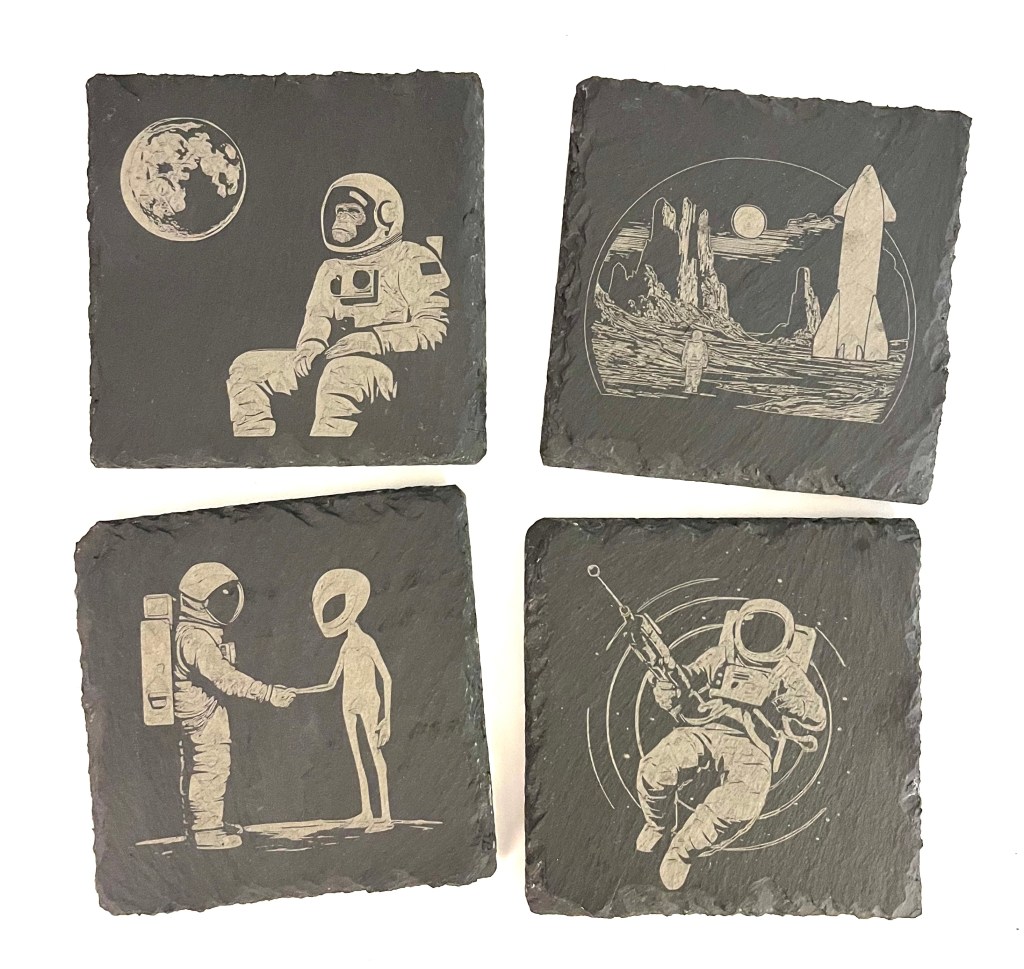
For fun, scifi themed coasters, check out my Etsy shop here: https://scifideco.etsy.com

If you enjoyed this story, be sure to share the link with friends and sign up for my newsletter to never miss a new short story:
Your message has been sent

 Brian J Mundell