I went to the moon against my will. Pressured, really. If I could do it all over again, I would refuse. I’d stay home and find a wife, start a family. But it was a pivotal moment in our history. It was a great leap forward for civilization, as they called it. It was a chance to become a legend. And I was the best pilot on the planet. How could I say no?
The higher ups didn’t tell us much, just that it was going to be a long journey. According to the suits, the mission was meant to be exploratory. It was more than that.
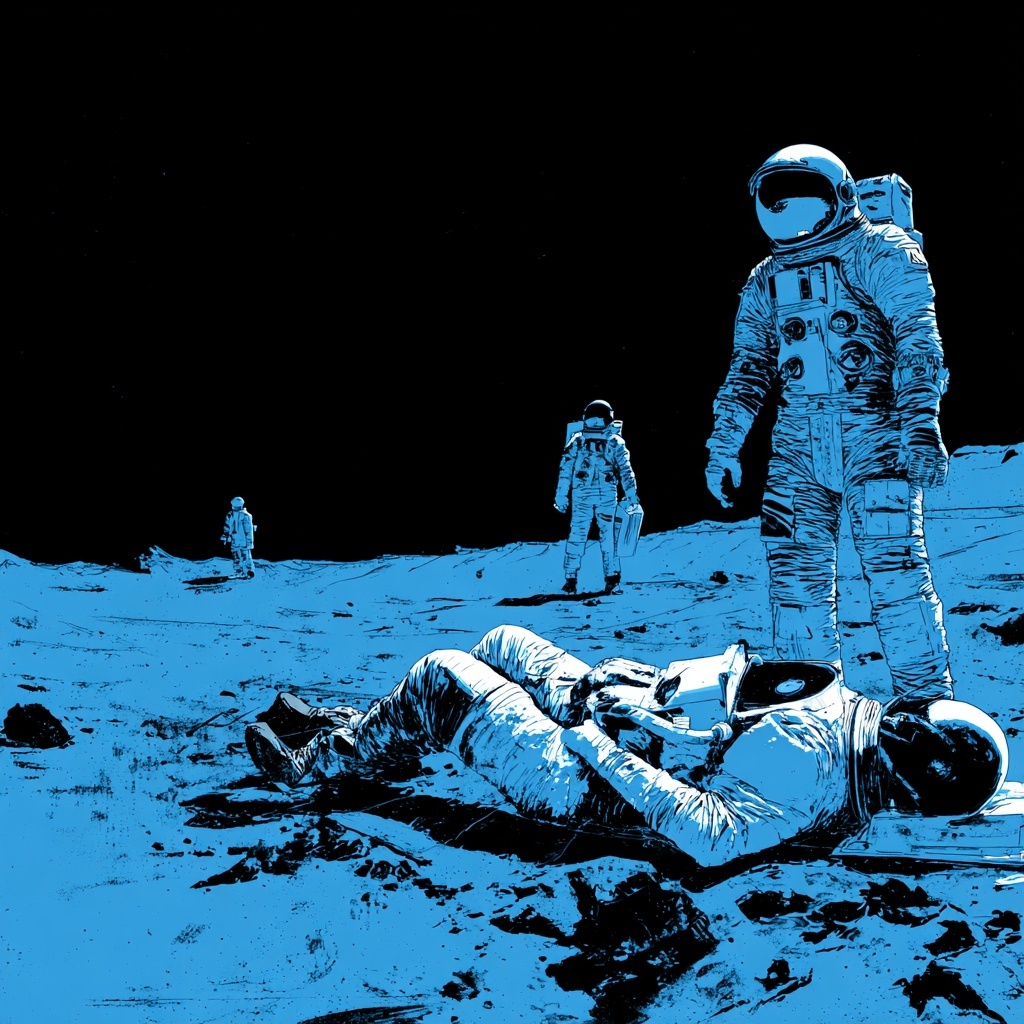
When we finally landed on the moon, my partner and I settled in. He did scans and took samples and ran experiments while I checked the equipment and surveyed the land. When I returned to the landing site, my partner was dead. Slaughtered. Two beings stood over his lifeless body.
They had beaten him—bashed his mask in and let the vacuum of space do the rest. A hole gaped in his helmet with remnants of cold-boiled flesh stuck to the shards of his visor. What was left of his face was puffy and blue, his bony jaw hanging loose. It was so primitive. His arms were reached out as he lay on the ground, stiff in his thick spacesuit.
Before I could react, my visor lit up and the heads up display locked onto those two beings. It was automatic. Preprogrammed. The display flashed green and my helmet started beeping. At that moment, I knew why I was sent there. Those damn suits set me up. I felt like bait, like a pawn in their cosmic chess game. They expected an alien encounter, and they were prepared for it. Just thinking about it makes my skin crawl. What they did to me there changed me forever.
The beeping grew faster and louder and I blacked out for a few minutes as the spacesuit did what it was designed to do.
When I came to, things were uncomfortably quiet. I was on the lunar module, orbiting the moon. Gazing out the window at the foreign body below, I saw it. The sleek black spacecraft, equipped with advanced technologies beyond humans’ wildest imaginations. It was nearly imperceptible to the naked eye, but I saw it. I knew it was there. And the craft would sit there, unclaimed, for decades. My eyes lingered until it disappeared behind the horizon. The lunar module rendezvoused with the command module shortly after, and I was on my way to Earth. This was just the first leg of a long mission, and I had work to do.
Upon landing on Earth, I was debriefed. Parts of my memory were cloudy, but the suits seemed to be able to fill in the blanks for themselves. Throughout all the questions and interrogations, I remained steady about one thing: I have to return. As much as I wish I had never gone to the moon, I campaigned for them to send me back any chance I got.
Every meeting, every debriefing, I pleaded with them to send me back to the moon. My voice cracked with urgency, but their eyes stayed cold, their lips pressed into thin lines. It always went the same way. They would stand there in their black jacket and clean-pressed white shirt and drone on, saying, “No further missions are planned,” or, “It’s classified.”
I wrote letters, filed formal requests, even cornered a senator at a gala once, his champagne flute trembling as I ranted about the spacecraft I’d seen. They all denied me. Every time. “National security,” they muttered, or “budget constraints.” Lies, all of it. I saw the way they exchanged glances, the way their hands twitched toward their pockets, like they were hiding something.
The rejections only fueled me.
That sleek black ship, its curves glinting faintly against the moon’s desolate backdrop, haunted my dreams. I’d felt it, that pull, when I saw it. Like it was calling me home.
Years passed. I stopped begging. The government had made their stance clear, and I wasn’t going to waste my breath on bureaucrats who’d sooner lock me away than listen. So I took matters into my own hands. I sold everything—my house, my car—and moved to a remote patch of desert, where the stars burned bright and no one asked questions. I built a workshop, then a lab, then an underground bunker.
I was a pilot, not an engineer, but I remembered everything I could about building spacecraft and found some suitable resources to learn more. The ship took shape in my mind first, then in sketches, then in the real world. I scoured black markets for materials, rare alloys, and tech that didn’t officially exist. Decades slipped by. My hair grayed, my hands shook, but the work consumed me. I barely slept, barely ate. The ship was my life. I’d wake in the middle of the night, scribbling equations or welding panels, driven by a need I couldn’t name. I was close—so close—when they came.
They showed up at dusk, three of them in black SUVs, dust swirling around their polished shoes. Government men, same as always. “We need to talk,” the lead one said, his badge gleaming. Agent Harper, it read. I invited them in. They’d been watching me, they said. Tracked shipments of restricted materials to my address. “What are you building out here?” Harper asked, his voice calm but his eyes sharp.
“Nothing,” I lied, my throat dry. “Just tinkering. Retirement hobby.”
They didn’t buy it. “Mind if we look around?” Harper said, and I knew it wasn’t a question. I’d spent years dodging their kind, growing paranoid, hiding my work. I learned my lesson that day on the moon. Suits don’t care about the people. But I also knew resistance was pointless. They’d tear the place apart if I didn’t comply. So I led them down the creaking stairs to the bunker, my heart pounding. The lab was dim, lit by flickering fluorescents, and there it was: my ship. It sat in the center of the room, a gleaming, obsidian thing, its surface smooth as glass, its shape defying every law of human engineering.
Their jaws dropped. Harper’s cool facade cracked, and the other two froze, hands hovering near their holsters.
“Harper,” one of them chirped. “This doesn’t look like the rocket we were briefed on.”
Of course it wasn’t a rocket. Rockets were crude, human things. I was capable of more. That sleek black spacecraft I saw on the moon was my inspiration and my destination.
“No,” Harper said. “How did you do this?” His voice was low, and dangerous.
“I built it.”
“Based on what you saw up there?” Harper surmised. “How’s that possible?”
“Based on things I learned when I was a schoolboy,” I uttered. These humans were so limited, so far behind in their thinking. My patience with them was wearing thin.
The third agent, a wiry man with a scar on his cheek, spoke up. “Maybe we should check up on his partner. He went to the looney bin with strange drawings. Maybe they were designs we just didn’t understand.”
My blood ran cold. “That fool was never my partner,” I said, my voice steady despite the rage building inside me.
Harper tilted his head, studying me. “Your partner, Jenkins, is in Woodland Psychiatric. Unless there’s something you’re not telling us…”
My eyes narrowed. I couldn’t help but smirk as I told them, “Jenkins wasn’t my partner. My partner died on the moon.”
All these years, they thought I was just a man—a human pilot obsessed with a mystery. I could see it in their eyes when it clicked. I wasn’t that man. Not really. Not anymore. I had taken human form, a familiar face they knew and respected, but on the inside I was someone else, from somewhere else.
Their hands were on their guns now, their faces tight with suspicion. I didn’t need to hide anymore.
“I was sent here from a world far away. My people—my real people—had sent me to the moon to intercept humanity’s first major spaceflight. I was their spy, their infiltrator, meant to blend in, learn, and report back. That ship on the moon isn’t some otherworldly curiosity. It’s my way home.”
Harper drew his weapon. The others followed suit. “Step away from the craft. Now.”
I smiled. For the first time in decades, I felt free. My human disguise had limits, but I wasn’t human anymore—not fully. I moved faster than they could react, my hands crackling with energy I hadn’t known I possessed until that moment. Harper fired, but the bullet never reached me. It disintegrated midair, caught in a pulse of light from my outstretched hand. The other two screamed, but it was over in seconds. Their bodies hit the floor, charred and lifeless. The air was thick with the smell of burned cotton. Smoke wafted from their polyester ties.
I turned back to the ship—my ship. It hummed softly, as if welcoming me. I wasn’t done yet. The moon was waiting, and beyond it, my home. I’d been a prisoner on this planet long enough. It was time to go back. There were more suits to fry.
For fun, scifi themed coasters, check out my Etsy shop here: https://scifideco.etsy.com
If you enjoyed this story, be sure to share the link with friends and sign up for my newsletter to never miss a new short story:


 Brian J Mundell