
For a long time Paul Fiske has wanted to do something great. It didn’t matter exactly what that was. He just wanted to do something heroic, something he could be proud of, something that he would be recognized for. A simple desire, and perhaps a bit undefined, but a strong desire nonetheless.
Paul believed that to do something great required him to be in the right place at the right time. It never dawned on him that he had to seek out opportunities to do great things. He spent his adult life doing the practical things, waiting for opportunity to come to him. He knew he wasn’t particularly creative, or athletic. He was a fairly plain man. He knew that. But, he was a good man and he knew he was capable of being a hero if ever the need for a hero should arise.
This desire didn’t formulate until he was already a family man. He dreamed of doing heroic things when he was a boy, as every boy does—hitting the game winning homerun in the world series, saving a baby from a house on fire, becoming a surgeon and performing a heart transplant to save a life—but reality set in and he had to let go of such fantasies. He went to college and became a bookkeeper and studied for exams to further his career. His parents were very proud. Along the way he found Margaret, the love of his life. They married after he officially became an accountant. Their honeymoon was in South Dakota to see Mt. Rushmore. Shortly after, they had a daughter named Hope. She’s nearly a teen now.
Everyone told him how great he was for being a steady and reliable husband and father. He provided for his family dutifully. He never truly had to protect them, but he was always on the lookout for danger. Paul was well liked in the community. He was nothing special, but he did everything right. Paul loved his family, but looking back on his life, he felt he had no great accomplishments.
When this empty feeling crept into his mind, Paul usually had a physical reaction to it. His stomach felt uneasy, his arms felt heavy, and his heart made every beat known. He couldn’t focus on his work in this state of mind, so he stood up to go for a walk. Moving forward made him feel like he was staving off the regrets of his past.
Graham & Brown was a mid-sized accounting firm; Paul was on the verge of becoming a partner there. They occupied two floors in a six floor office building. When Paul felt the need to go for a walk, a need that was increasingly frequent, he strolled down to the basement where they kept old records to make it seem like he was staying busy. He wandered through a maze of file cabinets in the half lit basement, sorting through his thoughts, trying to conjure a feeling of satisfaction that was always well outside his grasp. Then, the lights grew bright and the building shook and structures buckled above him. A shelf came down and darkness took over.
When Paul came to, he knew that something was desperately wrong in the building. Shelves and cabinets had fallen throughout the basement and the lights were off, except for one in the distance which flickered dimly. A shelf laid on top of Paul, just barely propped up by a second shelf beside him. Thick clouds of dust—concrete, sand, and sheetrock—floated in the air. Paul wiggled his way out from under the shelf. Remarkably, he was in one piece. There were no injuries aside from a bump on the head. Still lightheaded, he staggered his way to the stairs, unsure of what was left of Graham & Brown.
He pulled open the heavy metal door at the top of the stairwell that led to the lobby of the office building and was dismayed by what he found. The glass windows were shattered and there was rubble along the perimeter of the building; hardly any light came through. The ceiling in the lobby was slanted. Parts of it had fallen through. He made the realization that something truly terrible has happened. Not just to the building, but to the city. Maybe even the state. Or the country.
Paul thought about his wife and daughter. They would have been at home on this summer morning, roughly ten miles away. He pulled out his cell phone, but there was no service. He figured either they were safe or they weren’t. And if they weren’t, there wasn’t much he could do.
A large light fixture had crushed the two baristas behind the counter of the coffee shop. Paul decided he had to get to the third floor to see if there was anyone left to save. He walked across the slanted lobby floor around broken paneling, mangled chairs and tables, and boulders of concrete, toward the main stairwell.
The stairwell seemed surprisingly untouched. It was completely empty aside for sturdy steel beams and concrete fixtures. He climbed the stairs with ease up to the third floor. Exiting the stairwell, he found himself among the shattered remains of Graham & Brown. The reception desk was broken to pieces. Jordan Barr laid lifeless—her eyes were wide and red, her skin gravely white and varicose. She had no pulse.
Paul entered the main floor of the office, or at least went as far as he could go. The ceiling above collapsed onto the third floor. His coworkers were crushed. Desks were strewn about and turned upside down. Piping and wiring made a dangerous mess.
“Hello?” he shouted. There was no response. He desperately wished there was a response.
He used the collapsed ceiling as a ramp to the fourth floor. He climbed over rubble and debris, cutting his leg on a metal girder. The sting of the wound energized him. He breathed deep and aggressive and climbed onward, determined to help anyone still alive.
There was an excitement in the back of his mind. This all seemed very extreme and unnerving, but it was an opportunity to step outside of his former self. The earth had turned up and became something entirely different. Surely, he was allowed to do the same. He could be this new person for all to see, and maybe everyone else would be new, too. Whoever was left, anyway.
“Helllloooo?” he shouted when he had his feet planted firmly on the fourth floor. It seemed each floor up was progressively worse. An entire corner of the fourth floor, and all the floors above it, had collapsed and slid down to the streets below. Paul could see the other office buildings and cathedrals and apartments across the small city. It was the same all over.
“Hello?” a woman groaned. “Help! Please, help!”
Paul climbed his way around the gaping hole in the center of the fourth floor and approached the voice. There were bodies all around; anyway who was crushed looked much like Jordan Barr—pale, red eyes, and accentuated veins. Many were bleeding from the ears.
He saw an arm reach out from around a desk. “I’m coming,” he said.
“Paul,” the woman said. “Is that you?”
“Yeah.” He hopped across a small section of collapsed floor, entered what used to be Arthur Graham’s office, and poked his head around the desk. Graham’s assistant, Linda, was under the wooden desk with her leg pinned by a large slab of collapsed concrete which leaned on the desk above her.
“I’m gonna get you out. Okay, Linda?” She nodded. Her face was dusty and she couldn’t but pout, trying desperately to keep it together.
Paul planted his feet and pushed the concrete. If he could tilt it off the ground—even just a little bit—he could get her out. He pushed with all his might, until he was red in the face. It didn’t budge.
“It’s no use,” she said. Her chin was quivering now.
Paul shrugged off the comment, took a few heavy breaths, and pushed on the rock from a different angle. He gave it everything he had; his veins popped and his eyes bulged. The slab lifted just a little bit. She started to cry out in pain. Paul directed all of his energy and the slab lifted a little bit more and she slid her foot out reluctantly. She passed out, leaning against the desk.
“Linda,” Paul said, holding her face. “Linda, come back to me.” Her foot was completely mangled up to her calf. She opened her eyes, mouth relaxed, breathing slow.
“I’m gonna get you out of here,” Paul assured her. “I know the way out. We’ll get you a doctor. You’ll be alright.” She faintly shook her head no, but Paul paid no attention. He scooped her up and struggled his way to the stairwell where the coast was clear. He clamored down as quickly as he could.
Her breathing became long, drawn out breath. “My back,” she mouthed. She didn’t have the strength to speak.
“Stay with me,” he said. Paul was calm and resolute. This was his moment. She was his baby in the burning building. He just had to get her out and hand her off to a doctor. A simple thank you would be its own reward.
He got to the bottom of the stairs and kicked open the door to the lobby. The main doors to the building were glass and, as such, completely shattered. He strided out the doors with her in his arms. The streets were quiet. He paused and looked in both directions. “The hospital’s that way,” he nodded.
“Stop,” she whispered. “There’s no one.” Her eyes quivered and closed. “There’s no one,” she exhaled.
Paul froze for a second. “Linda?” She was gone.
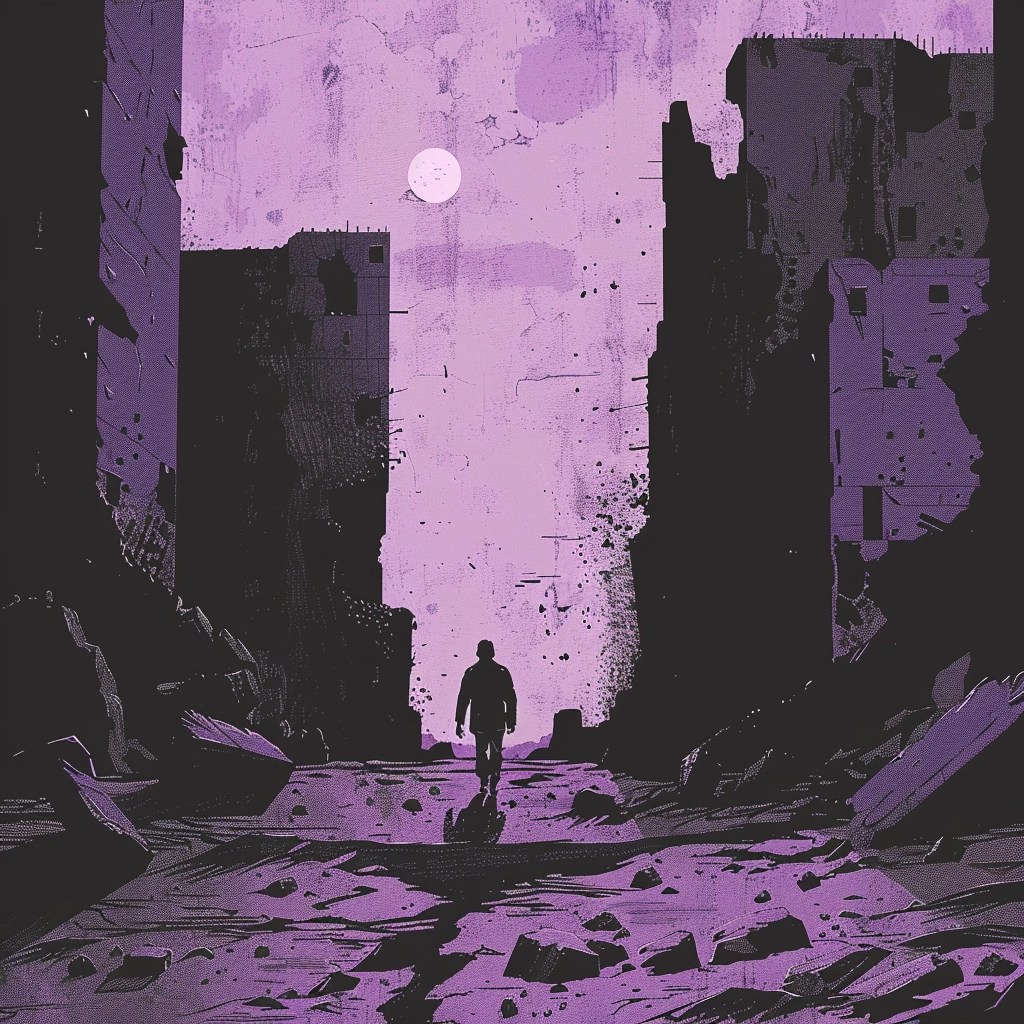
He laid her down on the rubble covered street, stepped back and let the reality sink in. He got her out, but there was no happy ending. The city was decimated. The buildings were collapsed. The cars were crashed. The bodies were pale. And all was quiet. There was no one. An empty feeling came over him. In this strange new world, all Paul could do was walk.
For fun, scifi themed coasters, check out my Etsy shop here: https://scifideco.etsy.com
If you enjoyed this story, be sure to share the link with friends and sign up for my newsletter to never miss a new short story:


 Brian J Mundell